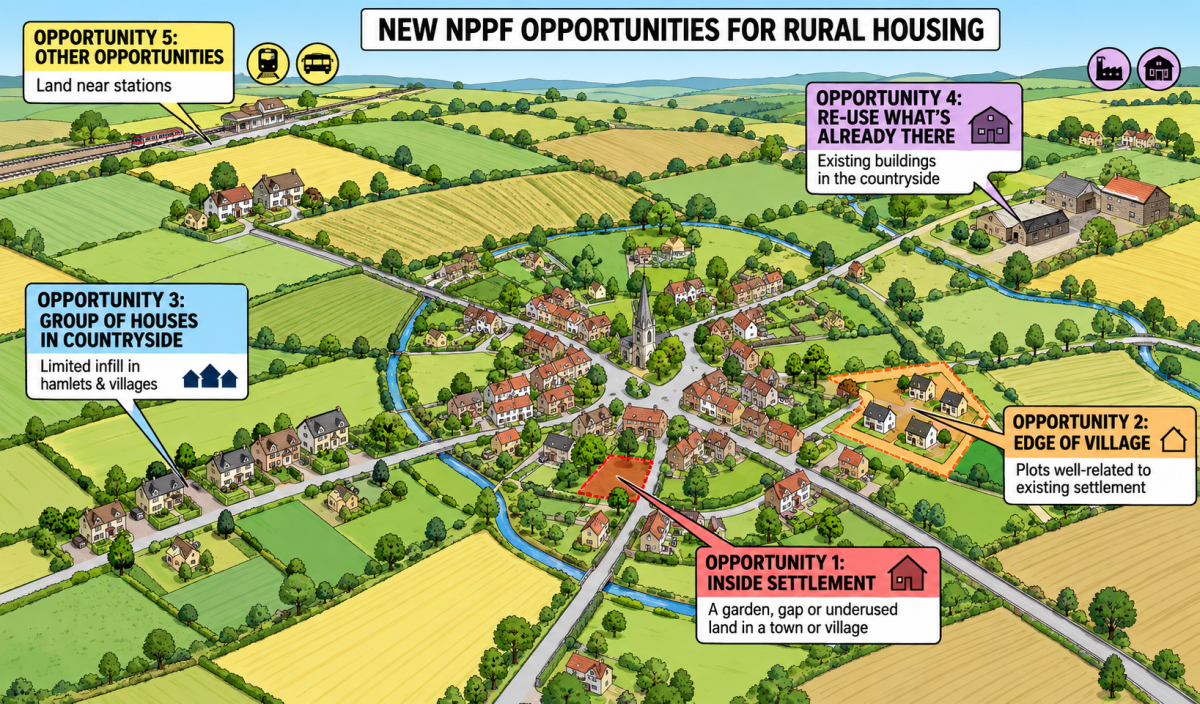
If you own a large garden, paddock, redundant building or piece of land on the edge of a village, you may have been told at some point:
“You’ll never get planning permission on that.”
Perhaps the land sits just outside the settlement boundary.
Maybe somebody looked at it several years ago and decided it wasn’t viable.
Perhaps a planning application has already been refused.
Or maybe you’ve simply never known what to do with it.
For many property and landowners, that can mean sitting on an asset for years without really knowing whether it has development potential.
Recent changes to the National Planning Policy Framework (NPPF) mean it could now be worth asking the question again.
The problem: “My land is outside the village boundary”
This is something we regularly see.
A landowner has a paddock, garden or field adjoining existing houses, but the settlement boundary runs between the existing properties and their land.
Historically, that line could create a significant planning obstacle.
The revised NPPF means the situation can be more nuanced.
The relationship between a potential development site and the existing settlement can now be particularly important in certain circumstances.
So, rather than simply asking:
“Is my land inside the settlement boundary?”
we may also need to consider:
“How well does my land relate to the existing settlement?”
That could create opportunities for some landowners whose sites have previously been discounted.
It doesn’t mean every field adjoining a village will receive planning permission. But being outside the settlement boundary shouldn’t necessarily be the end of the investigation.
The problem: “I’ve got a huge garden, but I don’t know if it’s worth anything”
You don’t necessarily need to own acres of development land.
Sometimes the opportunity is much closer to home.
A particularly large rear or side garden could potentially accommodate another dwelling or a small number of homes.
Likewise, an unused gap between existing properties or another underused parcel of land within a town or village could have potential.
For a property owner, that raises an important question:
Could part of your existing property be worth considerably more as a development opportunity than simply remaining as garden?
The answer will depend on access, character, neighbouring properties, trees, ecology, drainage, design and numerous other considerations.
But until the site is properly assessed, you may simply not know.
The problem: “Planning was refused years ago”
A previous planning refusal can understandably put an owner off trying again.
But a refusal doesn’t necessarily mean:
“This land can never be developed.”
The important questions are why it was refused and when.
Planning policy changes.
Local plans change.
Housing requirements change.
Housing land supply changes.
The Housing Delivery Test changes.
And national planning policy has now changed.
If your land was considered five, ten or even twenty years ago, there may be merit in reviewing the original reasons for refusal against today’s planning environment.
The answer may still be no.
But it might not be.
The problem: “I’ve got an old building that isn’t doing anything”
Perhaps you have an old workshop, commercial building, agricultural structure or another redundant building sitting on your property.
The obvious assumption can be that development requires a vacant piece of land.
It doesn’t always.
The revised planning framework continues to provide circumstances where existing buildings in the countryside can potentially be reused or redeveloped.
For some owners, therefore, the development opportunity may not be the field surrounding the building.
It could be the building itself.
The problem: “I’m close to a railway station, but never thought that mattered”
It could matter considerably.
The new NPPF places greater emphasis on development around well-connected railway stations as part of the Government’s approach to sustainable development.
If you own property or land within walking distance of a station, its location could therefore be an important part of assessing its development potential.
This doesn’t mean that every piece of land near a station can be developed, particularly where Green Belt and other restrictions apply.
But it is another reason why assumptions made about a property several years ago may need revisiting.
The problem: “I don’t want to spend thousands on planning if I don’t know what my land is worth”
This is perhaps one of the biggest concerns for landowners.
You discover that your land might have potential.
What next?
Do you appoint an architect?
Submit a planning application?
Spend money on surveys?
Approach a developer?
Sell the land as it is?
This is where we believe landowners need to be careful.
Planning permission isn’t the objective in itself. Maximising the opportunity from your land is.
Before committing significant money, it makes sense to understand both the planning and commercial position.
For example:
What could realistically be built?
What would developers actually want to build?
What could the land potentially be worth?
Should you obtain planning permission yourself?
Could a developer take the planning risk instead?
Could several developers compete for the site?
There isn’t one correct answer for every landowner.
You don’t necessarily have to fund the planning process yourself
This is another misconception we often encounter.
A landowner may have development potential but simply doesn’t want to spend tens of thousands of pounds pursuing it.
That doesn’t necessarily mean the opportunity has to be abandoned.
Depending on the site, there are different ways a transaction can be structured.
A developer might take the planning risk through an option agreement.
A sale could be agreed subject to planning through a conditional contract.
Alternatively, an owner might decide to pursue planning themselves before taking the site to market.
The right approach depends upon the site, the owner’s appetite for risk and the potential uplift in land value.
Could you be sitting on an opportunity without realising it?
This is perhaps the most interesting consequence of the new planning environment.
Across England there are property owners with:
- large gardens;
- paddocks adjoining villages;
- gaps between existing houses;
- small fields beside residential development;
- redundant buildings;
- land near railway stations; and
- sites where planning has previously been refused.
Many will have owned them for years without considering them development opportunities.
Others will have been told years ago that development wasn’t possible and never looked at the site again.
The new NPPF doesn’t mean all of these sites can suddenly be developed.
But it does mean that some long-held assumptions may deserve to be challenged.
That’s where UK Land Consultancy can help.
Before spending substantial sums pursuing planning, we can look at the opportunity from a land, planning and development-market perspective.
If there appears to be potential, we can then help establish the most appropriate route forward – whether that’s further feasibility work, pursuing planning, approaching suitable developers or taking the land to market.
And if there isn’t a realistic development opportunity, sometimes knowing that before spending significant money is equally valuable.
Have you got a piece of land you’ve always wondered about?
It could be worth taking another look.